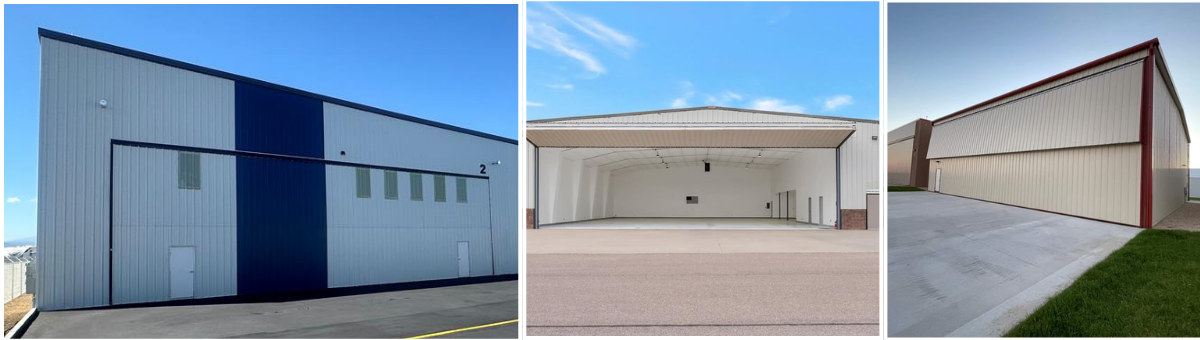
The $10 Million Hangar: When Does it Make Economic Sense?
Given the hangar shortage pilots know all too well these days, you may be quick to think that any newly built hangar will be a homerun of an investment.
While that may be true in some scenarios, whether a hangar project makes financial sense depends heavily on the local market and size you build. A hangar sized for a PC-12 will command a significantly different rent than one sized for a Global.
Hangar Construction Costs
There are many factors that determine whether a project ‘pencils.’ Some costs and considerations that occur during the due diligence period, before a shovel hits dirt, include:
- Land Acquisition
- Most airport properties are on a ground lease, with a lease duration set by the airport authority. Understanding the lease terms and length is an integral step in your due diligence efforts.
And like any other commercial real estate property, location is a key factor in a project’s success. Is the proposed site close to fuel, customs, an FBO, and parking?
- Permitting & Planning
- There may be requirements to get the property up to a shovel ready state, including doing an environmental or geotechnical study or an increased level of site prep to level the land. Plans to accommodate larger aircraft may require additional subgrade work to support these aircraft’s weight.
Additionally, what local building codes and FAA rules are there, including any of those imposed by the airport authority?
- Fuel Availability
- Is it possible or worthwhile for the hangar to have its own fuel source? If this is not possible, whether by cost or airport master plan constraints, the on-field FBO(s) may be able to create a custom agreement for lower fuel prices.
There are other budgetary line items to include in your development estimate, including utilities, fire protection systems, financing, and more.
Marketing, sales, and administrative costs also affect the viability of a project. Enlisting the support of an experienced aviation real estate professional will help ensure that the project is presented to the right aircraft tenants or buyers.
Summary of Development Costs
The tables below show representative estimated cost breakdowns for three hangar sizes.
Generally, the construction costs increase as the size of the hangar increases, but so do the potential rents. You will have to determine which size of hangar will be best received by your local market.
It’s also important to note that building cost rates don’t always go down as the hangar gets smaller – economies of scale can have a dramatic on rate efficiency.
Large Hangar
| Square Feet | Cost / SF | Total Cost | |
| Office | 3,600 | $320 | $1,152,000 |
| Hangar (28′) | 24,000 | $250 | $6,000,000 |
| Ramp / Parking | 41,400 | $25 | $1,035,000 |
| TOTAL | 27,600 | $296.63 | $8,187,000 |
Mid-Size Hangar
| Square Feet | Cost / SF | Total Cost | |
| Office | 1,200 | $200 | $240,000 |
| Hangar (24′) | 14,400 | $190 | $2,736,000 |
| Ramp / Parking | 23,400 | $25 | $585,000 |
| TOTAL | 15,600 | $228.27 | $3,561,000 |
Small Hangar
| Square Feet | Cost / SF | Total Cost | |
| Office | — | — | — |
| Hangar (20′) | 10,000 | $140 | $1,400,000 |
| Ramp / Parking | 15,000 | $25 | $375,000 |
| TOTAL | 10,000 | $177.50 | $1,775,000 |
Value-Add Elements
- Adding office space to an aviation-use building will increase the viability of renting the hangar, as many tenants have needs for meetings, flight planning, and other space near their aircraft.
- An integral feature of a hangar is its door size, which dictates how large of an aircraft can fit inside. A 28-foot-tall hangar door can accommodate most current ultra-long-range business jets.
- There should also be ample ramp space for aircraft to move freely and be parked temporarily.
Does it Make Sense?
Below is a summary of expected rents from the three hangars presented above:
| Hangar Type | Development Cost / SF | Target Yield on Cost | Implied NNN Rent / SF (Annual) |
| Large Hangar | $296.63 | 7.00% | $20.76 |
| Mid-Size Hangar | $228.27 | 7.50% | $17.12 |
| Small Hangar | $177.50 | 8.00% | $14.20 |
Can your market support those rents for on a long-term lease basis?
Yes, maybe. But a distinction should be made: these three hangar projects may bring a 7.00% to 8.00% target yield on investment, at the estimated construction costs.
Any increased in those costs, or a lower annual rent per square foot, will reduce the yield and total rent achieved each month.
Ultimately, a hangar project makes sense only if the local market can support the rent needed to cover development costs and produce the desired return. Hangar size, construction costs, and the types of aircraft in the market are all relevant factors that determine a project’s success.
Before moving forward, make sure the project is sized for actual demand and that the numbers still work if costs increase or rents fall short.